

Medical Insurance for Expats in Southeast Asia: Let’s Have an Honest Chat!
Have you ever looked at the cost of medical insurance and thought, “There’s no way I’m paying that every year!”?
Or perhaps you’ve already got a few health problems, you’ve reached an age when insurance premiums start getting uncomfortable, and you’ve quietly wondered whether there’s any point in even applying.
If any of that sounds familiar, you’re certainly not alone.
Living in Southeast Asia can be a wonderful experience. Whether you’ve settled in Thailand, Vietnam, Cambodia, Malaysia, Indonesia or somewhere else in the region, one of the attractions is that life can sometimes be more affordable than back home.
You might enjoy a better lifestyle, eat out more often, travel a little further and generally get more from your money.
Mention health insurance in an expat group and you’ll often get a lively discussion. Some people insist you should never live abroad without it. Others say they’ve been uninsured for years, have saved a fortune in premiums and have no intention of changing their minds.
And somewhere in the middle are people who aren’t quite sure what to do.
Perhaps that’s you.
Maybe you’re approaching retirement. Perhaps you’re already retired and living on a pension. Maybe you’ve got diabetes, high blood pressure or another condition that makes getting insured more complicated.
Perhaps you simply look at the annual premium and think, “I’d rather keep that money in my bank account.”
I understand why people feel that way. Insurance isn’t cheap, and paying for something you might never use isn’t an especially attractive proposition.
But there’s another side to the argument, and it’s worth having an honest look at it.
So, let’s talk about why many expats avoid medical insurance, why it might still be worth considering, and what you can do if your health or finances make things difficult.
10 Reasons why Expats are avoiding Medical Insurance
1. “I’m getting older, and the premiums are ridiculous!”
This is probably one of the most common complaints.
You might have been perfectly happy with your insurance when you were younger. Then the renewal arrives, and suddenly the premium has jumped again.
You start wondering how much you’ll be paying at 70, 75 or 80.

Brain hemorrhage treatment for Expat

If you’re living on a fixed pension, those increases can be particularly worrying. You’ve worked hard for your retirement, and the last thing you want is for medical insurance to eat up an ever-larger share of your income.
It’s understandable that some people eventually decide they’ve had enough.
But here’s something worth considering: before giving up completely, see whether a different type of cover might work better for you. A local plan, a higher deductible or a policy focused mainly on major hospital bills might be worth investigating.
It won’t suit everyone, but it’s worth asking the question before assuming there are no alternatives.
- “I’ve already got too many medical problems.”
This is where things become personal.
Perhaps you’ve got diabetes and high blood pressure. Maybe you’ve had a heart problem, undergone surgery or been diagnosed with something that requires regular treatment.
You may worry that an insurer will reject you outright or offer a policy that excludes the very things you’re most concerned about.
And if you’ve got several conditions rather than just one, the whole process can feel overwhelming.
You might even think, “What’s the point of applying? They’ll never cover me anyway.”
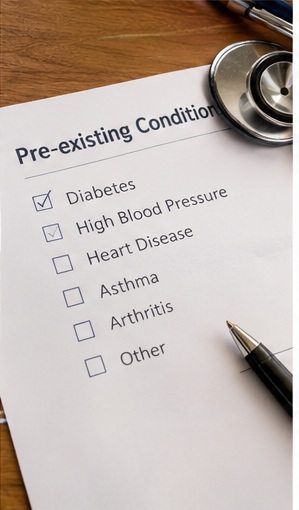
The difficulty is that pre-existing conditions can affect insurance in different ways. An insurer might exclude a particular condition, offer cover under special terms, charge more or decline the application.
There’s no guarantee you’ll find a suitable policy.
However, it’s worth checking what is actually available rather than automatically ruling yourself out. You might discover that some cover is possible, even if it’s not the comprehensive policy you originally wanted.
Just be sure you understand exactly what’s covered and what isn’t.
- “I’d rather keep my money and pay for treatment myself.”
I can understand this argument, too.
Imagine paying thousands of dollars every year for insurance when you’ve hardly visited a doctor in the past five years.

You look at all those premiums and think about what you could have done with the money instead.
For some financially secure people, paying for routine treatment themselves is a perfectly reasonable choice.
The important question is what happens when the bill isn’t routine.
A consultation or a course of medication is one thing. An operation, a prolonged hospital stay or intensive care is something else entirely.
If you choose to self-insure, do you have sufficient accessible savings to cover a serious medical event without putting your retirement at risk?
That’s the question I’d want to answer honestly before making the decision.
- “I’ve been here for years, and I’ve never needed insurance.”
You might have lived in Thailand or elsewhere in Southeast Asia for ten or fifteen years without any major health problems.

You’ve paid cash for consultations, bought medication when necessary and found local healthcare affordable.
So why change a system that seems to have worked perfectly well?
It’s a fair question.
The trouble is that our health doesn’t always follow the plans we’ve made for it. We can go years without needing much medical attention and then suddenly find ourselves dealing with an unexpected illness or accident.
That doesn’t mean everyone must buy insurance. It simply means that a good run of health shouldn’t be confused with a guarantee that things will always remain that way.
- “Insurance companies always find a reason not to pay.”
Perhaps you’ve experienced a disputed claim yourself. Maybe a friend has told you a horror story, or you’ve read an expat forum full of complaints about exclusions and rejected claims.
It’s hardly surprising that you might become sceptical.
And to be fair, insurance policies can contain conditions that aren’t always obvious when you’re reading the sales brochure.
A condition might be excluded. A waiting period might apply. Certain treatment might require approval, or a claim might fall outside the policy’s limits.
That’s why it’s so important to understand the contract before buying.
Ask awkward questions. Get important answers in writing. Find out how claims work and what happens if you need expensive treatment.
Don’t buy a policy simply because someone tells you it’s the best one.
- “What if I pay all that money and never use it?”
This is another understandable concern.
We naturally like to feel that we’re getting something back for our money.
With insurance, though, the benefit isn’t necessarily a payment every year. It’s financial protection if something covered happens.
Think of it as a safety net rather than a savings account.
You might pay premiums for years and never make a significant claim. Alternatively, you might need treatment that would otherwise cost far more than you could comfortably afford.
Of course, the numbers have to make sense for your own circumstances. Insurance isn’t automatically the right choice at any price.
But it is worth judging it by the risk it helps manage, not just by whether you’ve claimed this year.
- “The premiums will only get worse as I get older.”
For many older expats, this is the worry that never really goes away.
You might be able to afford the policy today, but what happens in another five years?

Will the premium still fit your budget? What if it rises at the same time that your pension income stays the same?
Unfortunately, no one can promise that premiums will remain affordable indefinitely.
Before taking out a policy, ask how pricing changes with age, whether premiums can be adjusted, what the renewal conditions are and whether there are age limits.
It’s much better to understand the long-term picture now than to be surprised by a renewal notice later.
- “Healthcare here is good, and it doesn’t cost that much.”
Many expats have discovered that Southeast Asia offers excellent healthcare, including highly regarded private hospitals in several major cities.
For everyday medical needs, paying directly can often feel straightforward and affordable.

If you’ve had good experiences with local doctors and hospitals, it’s natural to wonder whether international insurance is necessary.
The point isn’t to dismiss local healthcare. In many places, it’s an excellent option.
The question is whether you’re comfortable paying for all your treatment yourself, including the possibility of a complicated medical emergency.
Routine costs and major hospital bills are two very different things.
- “The policies are so confusing that I don’t know where to start.”
You start comparing policies and soon find yourself drowning in terms such as deductibles, co-payments, outpatient benefits, inpatient limits, waiting periods and geographical restrictions.

One policy appears cheaper, but then you discover it excludes something important. Another looks comprehensive, but you aren’t sure whether your existing medical conditions are covered.
It’s enough to make you close the laptop and forget the whole thing.
Try approaching it differently.
Start by deciding what you’re most worried about financially. Is it a major operation? Cancer treatment? Emergency hospitalisation? Or the cost of regular medical care?
Then compare policies based on those needs, rather than getting distracted by a long list of benefits you might never use.
- “I’ll sort it out later.”
We’ve all put off things we’d rather not think about.
Medical insurance can be one of them.

You might tell yourself you’ll look into it after the next holiday, when your finances improve or when you have more time.
But insurance is generally something you arrange before the event you want protection against occurs.
If you develop a new medical condition, obtaining cover for it may become more difficult or impossible under a new policy.
So, even if you’re not ready to buy anything, it can be useful to understand your options now.
You don’t have to make a rushed decision. Just don’t assume the same options will necessarily be available later.
Like to chat? Contact me HERE. No obligation. No pressure.